By Guy Osmond
Before suggesting ways to address the needs of individual workers in the future, it will help to define the context of how I see the current situation.
It is superfluous to point out that COVID-19 took everyone by surprise and even employers with comprehensive Business Continuity Plans were overwhelmed by the scale and precipitousness of events. We describe Phase 1, which began with lockdown, as ‘Rabbit in the Headlights’. In the early days, employers simply had to make sure their IT and communications systems functioned before they could consider anything else. If they had (or could find) enough laptops, that was a good beginning. Organisations with VOIP phone systems and proven team working tools (Teams, Slack, etc.) had a head start but many struggled.
Once the technological issues had been addressed, some employers started to think about the physical needs of their homeworkers whilst others elected to take no action for a few weeks and see what happened.
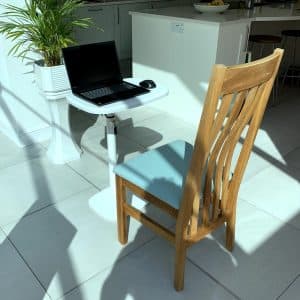 It soon became apparent that this was not something that would be over in a few weeks and, progressively, we saw all employers drawn into Phase 2: ‘Getting a Grip’. At this stage it is fair to say that levels of activity, vision, strategy and commitment were inconsistent! Some enterprises began to provide for the physical needs of their people with virtual assessments and products (chairs, laptop stands, second monitors, etc.), others started to think about mental health as well. Psychological wellbeing became a popular topic in the press and on TV and the more dynamic employers soon realised that previous wellbeing programmes needed to be revised, reinforced or extended to accommodate a very different corporate landscape.
At the time of writing, a large proportion of employers are still in Phase 2 but a growing number have moved or are moving into Phase 3, which we call ‘Command & Control’. This is the point at which an organisation starts to assess the data, take a holistic view of its collective personnel needs and create a strategy for the future. This is not an easy task. Apart from the obvious uncertainty of the pandemic trajectory and the likelihood of another wave, it is hard to anticipate government policy, guidelines or instructions and many organisations are also trying to plan for some sort of hybrid mix of home and office working.
It is my contention, however, that even those employers who are striding confidently into Phase 3 are not taking a sufficiently holistic view. This may be because of the enormity of the task. It may also be that the main board is failing to take sufficient ownership and leaving interpretation and implementation to middle management or, where silo cultures exist, essential inter-departmental conversations are simply not happening.
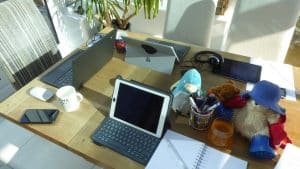 To understand the scale of the challenge, let us first consider the homeworker’s environment. The ability to be productive will depend on –
- the work location: Can they shut themselves away in a room? Are they working at the kitchen table with their partner or someone else? Do they even have enough space?
- the work setting: Is there enough light? Do they have a view? Is there any biophilic contribution – outside view or house plants?
- the other occupants: Are they sharing with someone who is also home working? Working nights? On furlough or unemployed?
- their other obligations: Dependent relative/s? Home schooling?
- their physical health and comfort: Do they have equipment or resources to implement good ergonomics, adopt good posture and minimise musculoskeletal stresses?
Next, we need to consider the individual’s resilience –
- their physical, mental and social health: Are they getting exercise? Are they eating properly? What are their drinking and smoking habits?
- their work relationships: Are they keeping in touch? What methods are being used? Are they enjoying home working? Do they miss their colleagues? Do they still feel involved? Do they feel neglected?
- their relationship with their line manager: How often and by what methods are they communicating? Does the manager understand how to manage by objectives? (This is often a major issue and few employers provide enough training and support in this regard for middle managers).
Finally, the home worker’s personality –
- are they introvert or extrovert?
- what are their personality strengths and weaknesses?
- do they find it easy to focus and buckle down?
- do they need the stimulus of human interaction or are they happy to work alone?
It is immediately obvious that the issues span many disciplines and departments in any large employer. HR, Occupational Health, Health & Safety, Wellbeing and Change Management make a good list to make a start but how to begin?
I think it is essential to start from the organisation’s corporate culture – the DNA as we call it in my business. How does that inform the relationships and behaviours in the business?
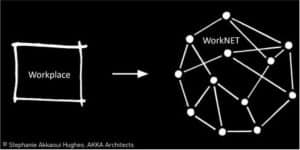 The Dutch architect, Stephanie Akkaoui Hughes, describes how we have now moved from Workspace and Workplace to WorkNet: a dispersed working environment where a business is defined by its people and the nature of their interactions rather than the place where they interact. Interactions, she states, are the fountainhead of innovation and relationships within an organisation and the basis for its survival and growth. However, whilst it is often easy to dictate such interactions and maintain the corporate DNA within a traditional workplace, you can only ever facilitate interactions within a WorkNet.
So what needs to be done?
To make a start on this enormous challenge, it is essential to identify your datum point and a snapshot of the current situation is essential. Many large employers use the Leesman Index which not only takes the pulse of the organisation but also benchmarks it against other employers on a national and global basis. For our own organisation, we have used the recently-established Champion Health assessment. This 30-minute survey provides an insight into the mental, physical and lifestyle health of all participating personnel, providing each individual with a confidential, personal report containing suggestions and recommendations in response to their answers. It also generates a consolidated, anonymised report of all personnel to highlight key issues for the employer. This data informs the development of a strategy to optimise both the effectiveness and the ROI of your wellbeing programme.
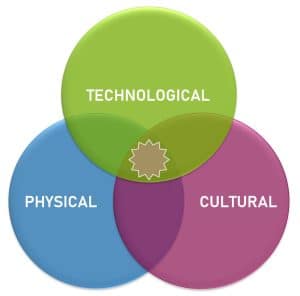 The traditional workplace is recognised as a tripartite environment where employee experience is impacted by Physical, Cultural and Technological factors. These same factors are at play in the WorkNet but each individual has less of a shared experience so interpretations are more diverse. To manage this, it is important to consider all the different environmental and personality issues referred to above but this must be shared with everyone. It is not just a management concern.
Our own approach to this is based on a practice we have followed for more than 16 years. All personnel complete a psychometric profile at the start of their employment and we use this and the related language in our day-to-day conversations. Our model is the Insights programme and the red-yellow-green-blue colour language is part of our vocabulary. All personnel understand the different character types, their respective strengths and weaknesses, where they fit into the bigger picture and how that diversity creates a collective strength and capability.
Once all of this is in place, ongoing monitoring informs what other actions or changes are required. It is easy to extend or adapt the wellbeing programme, adding or withdrawing services as necessary. Most critical are strong and consistent communications and a sustained and responsive training programme. Daily or weekly departmental Teams or Zoom meetings will help sustain the culture and promote interactions. Training may include resilience, mindfulness or health initiatives such as physiotherapy, alongside ongoing support for managers to effectively manage a geographically dispersed team.